Small pieces. Big builds.
What can 1,250 pop tabs become?
A working supply for jewelry, ornaments, sample panels, a larger statement piece or several makers testing ideas.

Facts · counts · crafts · drives · recycling
The surprisingly useful side of one very small piece of aluminum—what people make with pop tabs, how large projects scale, how groups plan collection goals and how to choose the right quantity.
61 direct answers
Showing all encyclopedia answers.
Try a shorter phrase such as “purse,” “bracelet,” “large project,” “drive goal,” “clean” or “pack size.”
Start with the possibilities
Short answers first. Open any question for the full explanation, assumptions and source notes.
A working supply for jewelry, ornaments, sample panels, a larger statement piece or several makers testing ideas.
Size, lining, strap design, overlap and connection pattern all change the total. A measured sample produces the strongest estimate.
A small representative panel reveals the real tabs-per-inch or tabs-per-square-foot rate before the full build begins.
Group size, collection days and tabs per person determine the pace. Use the goal planner below to test a real scenario.
The existing openings can hold cord, ribbon, jump rings, crochet and woven connections in many repeating patterns.
That is the PopTabs.store planning benchmark before packaging. Shape and batch variation can shift the measured weight.
Choose your next step
The Encyclopedia is the reference desk. These focused hubs take over when you are ready to make, organize, calculate or buy.
Count ↔ weight converter
Convert a count to approximate weight, or use a known weight to estimate the number of standard tabs. The range reflects normal variation among tab styles.
| Tab count | Planning weight |
|---|---|
| 1,250 | about 14 oz |
| 2,500 | about 1.75 lb |
| 5,000 | about 3.5 lb |
| 10,000 | about 7 lb |
| 25,000 | about 17.5 lb |
Estimate uses 1,430 tabs per pound, with a planning range of 1,400–1,500. For donation records, postage or an exact handoff, weigh the actual container and subtract the container weight.
Interactive collection planner
Turn a big number into one small, repeatable action. Enter the goal, number of participants and collection period to see the pace each person would need.
This calculator only divides the goal by the group and time entered. Actual collection rates depend on participation and access to cans.
Browse the encyclopedia
Every answer is visible and searchable. Start typing a question, choose a suggestion or use a topic filter to narrow the directory.
A pop tab is the small metal lever on the top of a beverage or food can. Lifting the tab pushes the scored opening inward so the can can be opened. On most modern cans, the tab stays attached after opening, which is why it is also called a stay tab. “Can tab,” “soda tab,” “pop top” and “pull tab” are common everyday names for the same general object.
Modern beverage-can tabs are made from aluminum alloy: aluminum is the primary metal, with other elements included to produce the needed performance. Alloy composition and tab design can vary by manufacturer and can type. For craft or donation use, the practical rule is to keep aluminum tabs and remove steel or magnetic pieces if the receiving program requires aluminum only.
In everyday conversation, the terms overlap. “Pop tab,” “can tab” and “pop top” commonly refer to the modern tab that stays attached to a can. “Pull tab” and “ring pull” can also describe older detachable designs that were pulled completely off. If a pattern or collector cares about the exact shape, compare the pictured tab rather than relying on the name alone.
The tab is designed as a lever, not as a craft component. Its two openings reduce material and help create the shape needed to lift and press the scored opening. Crafters use those openings as ready-made connection points for cord, ribbon, jump rings, crochet and woven patterns.
Some beverage brands coat or color tabs for branding, promotions or product identification. Crafters often use those colors as small accents, but a naturally collected assortment will not produce an even rainbow. For a repeatable palette, sort what you have first or plan to paint or coat standard silver tabs.
No. Standard beverage tabs are similar enough for many crafts, but the outer profile, hole shape, thickness and weight can differ. Energy-drink, food-can and specialty tabs may be larger or shaped differently. For a repeating pattern, build a small sample first; for precise symmetry, sort by shape before assembly.
Use about 1,430 standard tabs per pound for planning. PopTabs.store pack weights are based on that benchmark, while published charity and recycler estimates range from roughly 1,000 to more than 1,700 because tabs differ in size and weight. If the number will be used for an official donation total, count a sample from the actual batch or record the measured weight instead.
Ten thousand standard tabs weigh about 7 pounds using the PopTabs.store benchmark. A reasonable planning range is approximately 6.7 to 7.1 pounds before packaging. Use the converter above for other quantities, and add the box or container weight when estimating shipment weight.
One thousand standard tabs weigh about 0.7 pound, or roughly 11 ounces, using 1,430 tabs per pound. Different tab styles can shift that estimate. For a quick reality check, weigh 100 tabs on a small scale, multiply by ten, and subtract the empty-container weight.
Using the PopTabs.store planning benchmark, 25,000 tabs are about 17.5 pounds, 50,000 are about 35 pounds and 75,000 are about 52.5 pounds before packaging. These quantities can support school-wide launches, multi-station displays and extra-large builds. Actual weight shifts with the tab mix, so use the count as the product quantity and the weight as a handling estimate.
For exact counted packs, group tabs into repeated units—such as 25, 50 or 100—then combine those units and have a second person verify the totals. For a drive, weight is faster: count and weigh several representative samples, calculate the average tabs per pound, then weigh the full batch. Do not call a weight-based estimate an exact count.
Build a representative sample using the exact connection method, count its tabs and measure its finished width, height or length. Scale that sample to the planned dimensions, then add extra for sorting, edge changes, failed connections and repairs. A real sample captures overlap and weave density that a generic tabs-per-square-foot formula cannot.
A count connects the supply to a pattern, number of makers or visible project goal. Weight is useful for storage and handling, but differently shaped tabs can produce different counts at the same weight. A minimum-count pack gives the project a defined starting quantity while the listed weight helps plan shelves, boxes and transportation.
Using the PopTabs.store planning benchmark, one ounce is about 89 standard tabs. Because individual shapes vary, use that number for estimation rather than an exact donation record. The fastest exact method is to weigh a counted sample from the same batch and calculate its own tabs-per-ounce rate.
If each can contributes one tab, it takes 1,000 cans to collect 1,000 tabs. A few damaged or missing tabs can lower the usable total, so a craft project should collect beyond its exact design count. Recycle every can after removing the tab.
There is no dependable container-only conversion. Tab shape, how the container is filled and the amount of empty space can change the total by thousands. Weigh the filled container, subtract the empty container, then multiply the net pounds by about 1,430. That gives a defensible estimate without pretending every jug packs the same way.
Subtract the empty-container weight from the filled weight, then multiply the net pounds by your chosen tabs-per-pound benchmark. PopTabs.store uses about 1,430 for standard tabs: a 3.5-pound batch is therefore about 5,000 tabs. Use the converter above, and label the result as an estimate unless the pieces were actually counted.
Reserve 10–15% as a shared replacement pool, then divide the remainder by the number of makers or stations. For example, 5,000 tabs with a 10% reserve leaves 4,500 working tabs—150 each for 30 participants. Pre-bagging equal kits makes setup faster and keeps one group from using the entire supply early.
Many adult bracelets use about 18 to 25 standard tabs. A child-size bracelet may use fewer, while a wide or heavily overlapped pattern can use more. Measure the wrist, test the chosen weave with 6–8 tabs, and keep 10–20% extra for fit changes or damaged pieces. See the bracelet quantity guide.
A full-size pop-tab purse often lands in the several-hundred range. Existing examples and common layouts can require roughly 566 to 727 tabs, but size, lining, strap, overlap and crochet pattern change the total. Build and measure a small swatch, then use the Pop Tab Project Calculator rather than trusting a single universal number.
A 34-inch belt built about three tabs wide may use around 110 tabs, but buckle allowance, spacing and weave density matter. Make a 4- to 6-inch test strip, measure it without stretching, and scale that count to the finished length. Add extra tabs for the buckle end and mistakes.
Large projects can move into the thousands quickly. Planning references include roughly 544 tabs for one lampshade design, around 3,500 for a curtain and about 4,000 for a vest, but those are examples—not guarantees. Project dimensions and connection density control the result. Use a measured swatch in the project calculator for the strongest estimate.
Good first projects include a single-row bracelet, keychain, earrings, zipper pull, ornament or small flower. They use fewer tabs and let you practice orientation, lacing and finishing before committing to a bag or garment. Start with the Crafts Hub, then browse step-by-step tutorials.
Common connectors include ribbon, elastic cord, waxed cord, yarn, crochet thread, jump rings and jewelry wire. The right choice depends on whether the piece should stretch, drape or hold a rigid shape. Test the connector through the actual tab holes and inspect cut wire ends or metal edges before the item is worn.
Not always. Mixed shapes work well in loose, decorative and experimental projects. Repeating weaves, fitted wearables and symmetrical jewelry look cleaner and assemble more predictably when tabs are sorted by profile and hole shape. For a group activity, sorting can be a useful first station before assembly begins.
A simple pair can use 2 to 8 tabs total, depending on whether each earring uses one tab, a layered pair or a longer linked design. Keep extras so both sides can be matched by shape and finish. The ear wires, jump rings and decorations are separate from the tab count.
Most simple keychains use 1 to 10 tabs. A single decorated tab works as a minimalist keychain or zipper pull; woven and layered designs use more. Build the decorative section first, then add the key ring so the final length and weight feel right.
The answer depends on the weave and overlap. Make a flat sample, measure its area in square inches, then calculate: sample tab count × 144 ÷ sample area. If 30 tabs cover 25 square inches, the same pattern needs about 173 tabs per square foot. Use the Project Calculator to scale a measured swatch.
A vest-scale build can reach roughly 4,000 tabs. Sleeves, leg coverage, a hood and denser overlap can push a full costume far beyond that. Body measurements alone are not enough because the weave controls density; build a representative panel and scale it with the Project Calculator.
People collect tabs for charity fundraising, school service projects, recycling education, craft materials and community challenges. In a charity program, the aluminum is typically sold by weight and the proceeds support the organization’s work. The collection itself can also create awareness and make participation easy for classrooms, offices and families.
Contact the receiving organization and confirm that its pop-tab program is active, which tabs it accepts, whether it measures by count or weight, the deadline and the correct handoff location. For RMHC programs, McDonald’s current guidance is to check with the local chapter because participation is local. Save the confirmation with the drive plan so every collection station receives the same instructions.
Start with the official RMHC chapter finder, then check the chapter’s current pop-tab page or call before visiting. Some chapters accept tabs at the House, some use partner recyclers or businesses, and some no longer participate. A local metal recycler may also let you donate the proceeds to a chosen organization.
Do not assume every restaurant accepts them. Participation depends on the local operator and chapter program. Call the specific restaurant or local RMHC chapter first and ask for the current drop-off method. A chapter, named recycling partner or public collection site may be the correct destination instead.
Only if the receiving program accepts them and the tabs meet its material rules. Beverage-can tabs are commonly aluminum; food-can tabs can be aluminum or steel. A magnet can help flag many steel tabs, but the destination’s instructions control. When a program says “beverage tabs only,” follow that rule.
Local schools, service clubs, animal groups, hospitals and community fundraisers sometimes run their own tab collections, usually through a recycling partner. Programs open and close, so search locally and verify who receives the proceeds. If no organization accepts tabs, a scrap recycler may allow the metal value to be donated directly.
A single classroom can start with a visible 10,000-tab target; a grade, club or school-wide campaign may need a larger milestone. The best goal is easy to repeat, measurable and tied to the number of participants and campaign length. Use one public goal, then celebrate smaller progress marks on the way there.
Many programs care about accepted material and total weight, but policies are local. Ask the recipient whether purchased aluminum tabs are accepted, whether they require community-collected beverage tabs and how the donation should be labeled or packaged. Purchased tabs can also seed jars, create a kickoff display or support a counting activity while the community collection grows.
First confirm the receiving program, deadline and accepted material. Then set a measurable goal, choose visible collection points, assign one owner for counting or weighing, publish short updates and plan the final handoff. For full planning, read the Ultimate Guide. For a launch checklist and station tools, use the Drive Playbook.
Use tab count when a large round number will motivate participants; use pounds when the final donation is weighed or when counting would create unnecessary work. For schools of different sizes, pounds per classroom or per student can make a competition fairer. Publish one primary goal and, if helpful, show the approximate conversion beside it.
Only when the receiving organization specifically requests mailed donations and provides an address and packing method. Large tab quantities become heavy, so a local drop-off or approved collection partner may be simpler. Confirm the current handoff method before packing or paying for shipment.
A clear purpose, visible containers, a deadline, repeated reminders and public progress updates matter more than complicated rules. Give each collection point an owner, empty it before it overflows, and keep one central record. A starter quantity can make the goal look active on day one, but the community collection should remain the story.
Remove visible residue, wash sticky tabs with mild dish soap and water, rinse, and let them dry completely before sealing them in a container. For a large craft batch, a mesh laundry bag or colander can make rinsing easier. Cleaning needs vary by project and recipient, so follow any instructions from the charity, teacher or craft pattern.
Yes. Moisture trapped in a sealed bag or jar can create odor, residue or problems with labels and other mixed materials. Spread washed tabs in a single layer on a towel or drying rack, stir them once or twice, and package only when no moisture remains.
Use a clean, dry, closable container that matches the quantity: a jar or small jug for home, a lidded bucket or sturdy box for a group. For heavy batches, use multiple manageable containers instead of one oversized bin. Label the container with the group, date and measured count or weight if the receiving program tracks credit.
For crafts, sort by outer shape, hole shape, size and color. For an aluminum-only donation, remove obvious trash, coins, bottle caps and other metal pieces; a magnet can help identify many steel items, although not every non-aluminum metal is magnetic. Follow the recipient’s rules instead of inventing a purity standard.
Yes, aluminum tabs are recyclable. The accepted method depends on the local program. Very small loose items can be difficult for some sorting systems, so ask whether tabs should remain attached to cans, be delivered with scrap metal or be collected through a dedicated program. The U.S. EPA recommends checking local rules for all recyclables.
Remove it only when you are saving tabs for a specific craft or accepted collection program. Otherwise, keeping it attached helps the small piece travel through recycling with the can. Recycle the can either way and check local preparation rules; some programs also advise against crushing cans in single-stream systems.
Pop tabs are small metal parts and are not suitable for children who may put them in their mouths. Adults should inspect for sharp, torn or badly bent pieces, supervise cutting and wire work, and choose age-appropriate connectors. Finished wearables should be checked for exposed wire ends and rough edges before use.
Aluminum does not form the reddish iron oxide normally called rust. It can still oxidize, discolor or corrode under certain conditions, especially when stored wet or contaminated. Wash off residue, dry tabs completely and store them away from moisture before crafting or donating.
Open and empty the can first. Move the tab gently back and forth around the rivet until it separates; do not yank it toward your face or slide a finger across a torn edge. Discard tabs that split or become sharp, and supervise children rather than giving them can-removal work.
Hand washing in a contained colander or mesh bag is more controlled. Small metal tabs can escape, strike equipment or collect detergent residue in household machines. Mild dish soap, a thorough rinse and complete air-drying are enough for most craft and collection uses unless the recipient gives different instructions.
Ermal Fraze developed the removable pull-top can in 1959, eliminating the need for a separate can opener. The Smithsonian’s National Museum of American History notes that the patent was issued in 1967 and that most U.S. beer brewers had adopted the packaging by 1965.
Daniel F. Cudzik of Reynolds Metals developed the stay-tab design in the 1970s. The design keeps the tab attached after opening; the Smithsonian records that his “stay tab” or “ecology tab” patent was issued in 1976.
Detached pull tabs became litter and created cut and ingestion hazards. The stay tab solved the core problem by keeping the opening lever attached to the can. That is why an older ring pull and a modern stay tab may share a common nickname while having visibly different shapes.
The tab works as a lever. Lifting the rear changes the force around the rivet, allowing the nose of the tab to press down on the scored opening panel. The panel breaks along its score and folds inward while the modern tab stays attached to the can end.
Collectors often group tabs by opening design, outer shape, color, brand association, country or estimated era. A labeled tray or archival sleeve keeps small variations visible without mixing them into a craft supply. When the history is uncertain, record where the tab came from instead of assigning a date or brand that cannot be verified.
PopTabs.store offers counted packs for crafts, classrooms, displays and collection-drive launches. Choose the smallest size that covers the planned use plus a reasonable overage. If a craft requires uniform shape or a specific color, read the product description carefully because general assorted packs are not the same as design-sorted craft components. Compare available packs.
For one small craft, calculate the design first rather than buying by the pound. A 1,250-count pack suits multiple small projects or one several-hundred-tab build with room for sorting. A 5,000-count pack fits groups, classrooms or larger work. A 10,000-count pack is better for drive launches, displays or repeated group use.
Add roughly 10–20% above the calculated design quantity when shape consistency, fit or learning curve matters. The extra covers damaged pieces, pattern testing and tabs that do not match the preferred profile. For a loose collage or mixed-media project, a smaller buffer may be enough.
Methods vary by seller. PopTabs.store products are sold as minimum-count packs; the listed weight is a planning reference. Tabs are hand-reviewed before packing, while natural differences in shape, finish and color remain. Before buying elsewhere, check whether the number is an exact count, a minimum count or a weight-based estimate.
PopTabs.store assorted packs are primarily standard silver aluminum tabs, with colored tabs appearing as a small minority rather than an even rainbow mix. Exact colors and proportions vary. If the project depends on one color, plan to paint, coat or source a specifically color-sorted product instead of relying on chance.
Try a shorter phrase such as “purse,” “bracelet,” “drive goal,” “clean” or “pack size.”
A–Z reference
Useful terms for understanding patterns, products and collection instructions.
When the answer becomes a quantity
Start with the intended use. The right pack is the one that covers the project or launch without forcing a bigger purchase than the job needs.

Multiple small projects, one larger purse-scale build, or a shared supply with room for sorting.

Classrooms, workshops, garments, curtains or several makers sharing one counted supply.
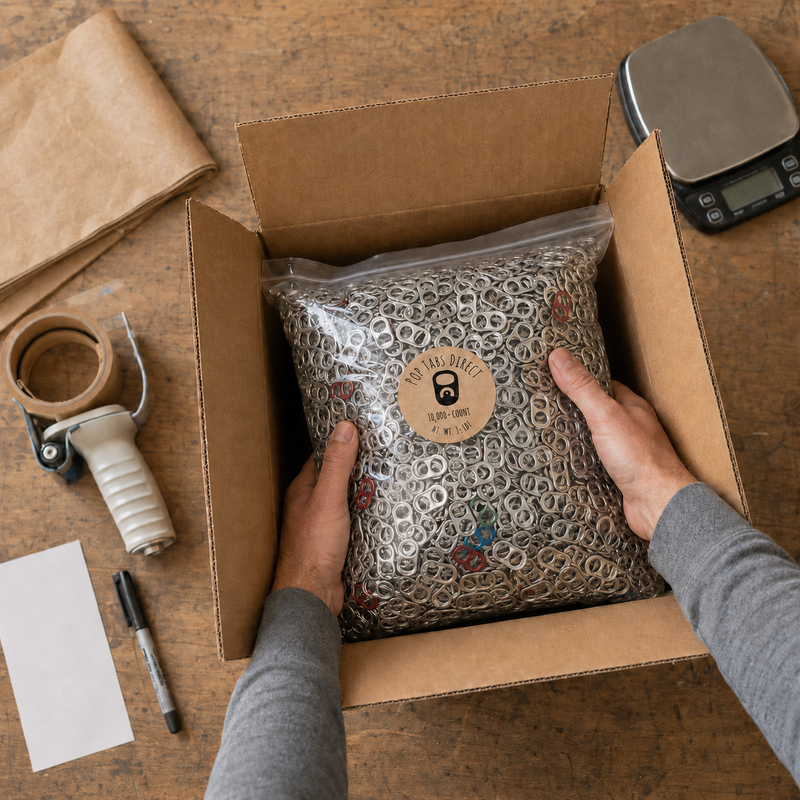
A visible kickoff quantity for a classroom, club, organization or focused collection station.
Counts describe the product quantity. Any tab-to-weight conversion on this page is an estimate because tab designs vary.
Source notes
Counts are labeled as planning estimates because different organizations publish different tabs-per-pound figures. Donation and recycling rules are local and should be verified at the destination.